·8 min read
T1 or T2, in plain language
Almost every discussion about T1 or T2 is a discussion about the route, the destination or the carrier. That is not where the choice sits. One question decides it, and that question is about the status of the goods themselves.
Which question decides between T1 and T2?
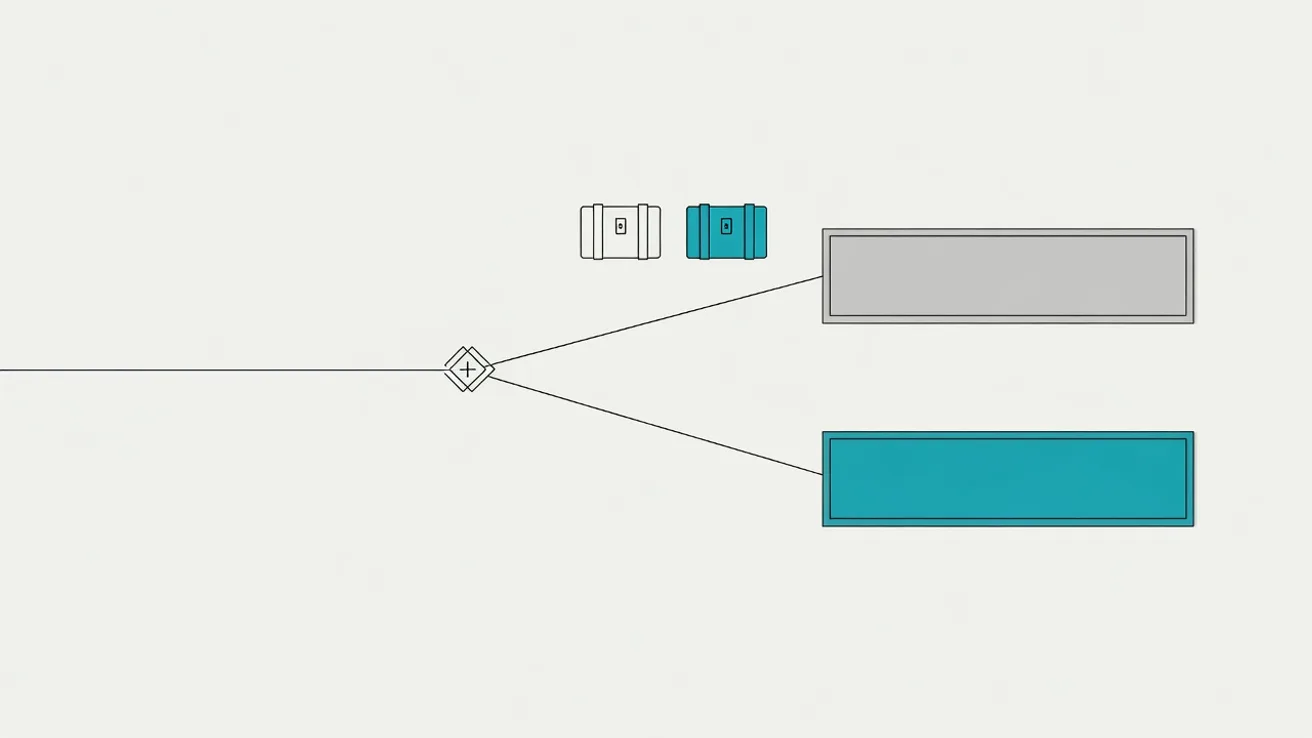
Ask one thing: are these Union goods or not. That is the whole decision tree. If the duty and the VAT have not been paid, it is a T1. If the goods are already in free circulation or were produced in the EU, and they have to leave the customs territory along the way, it is a T2. The route, the carrier, the value and the office of destination change none of that. They decide which office you enter and which time limit you get, but not the letter on the document. Anyone who starts from how the trailer drives ends up with the wrong choice. In practice the status question has usually been answered by the previous link in the chain. A container sitting in Rotterdam under temporary storage is non Union goods. A pallet leaving a factory in Brabant is Union goods. Doubt appears only when a consignment was cleared earlier, exported again, or comes out of a customs warehouse. Then you read back through the file, not through the waybill.
What is Union status and what is it worth?
Union goods are goods produced in the EU or goods on which the import duty has already been paid. That status buys one big thing: inside the Union they travel without a customs declaration. Rotterdam to Milan means no declaration, no MRN, no guarantee and no discharge. That is the normal situation, and it is why road transport inside the EU carries so little customs work. Union status is not the same as origin. A load of Chinese screws cleared in Rotterdam is Union goods of Chinese origin. Status says which duty has been paid, origin says where the goods come from and whether a preferential rate applies. Confusing the two has people asking for an EUR.1 when what they need is proof of status. That status is in principle lost the moment the goods leave the customs territory of the Union. That is exactly the moment a T2 becomes necessary, because it preserves what you would otherwise lose.
Which three situations does the choice actually turn up in?
The first is ordinary arrival. A container lands in Rotterdam and is not cleared there but at the consignee in Germany or at a warehouse inland. The goods are non Union goods, the duty is open, and the consignment moves on a T1 to the office of destination. Without that T1 the declaration would have to be made at the place of entry. The second is the trip that leaves the Union for a stretch. Union goods going from the Netherlands to Italy through Switzerland, or a trailer to Norway. The status has to travel with them, so you open a T2. Send the same load through Germany and Austria and nothing is needed, because it never leaves the customs territory. The third is removal from a customs warehouse. The goods lie there under suspension, so they are still non Union goods. Moving them to another member state or to another warehouse keeper is a T1 again. Clearing them on the spot is not transit at all but an import declaration.
What does the wrong choice cost?
The expensive mistake is the T2 that was never opened. The load drives through Switzerland, enters Italy, and is treated there as non Union goods. The result is an import declaration over the full value, with duty and import VAT on goods that were already settled in the Netherlands. It can be undone with proof of Union status, but that takes weeks, it runs through a foreign customs administration, and somebody has to be able to reconstruct a file from months ago. The reverse mistake is quieter. Put a T1 on goods that are already in free circulation and nothing travels under a suspension that had anything to suspend. At destination an open procedure sits there asking for a follow up declaration, and someone is tempted to close it with an import declaration on goods that were already imported. Both mistakes surface at the wrong end of the journey, with a party who does not know your file. That is where the real cost sits: not in the declaration fee, but in the weeks of correspondence after it.
How far does common transit reach?
T1 and T2 do not stop at the external border of the Union. The common transit procedure extends the same system to the countries that signed the convention: Switzerland, Norway, Iceland, Liechtenstein, the United Kingdom, Turkey, Serbia, North Macedonia and Ukraine. One declaration in NCTS therefore runs from Rotterdam to an office of destination in Oslo or in England. That is why asking whether something stays inside the EU is not always enough. Switzerland is a country of transit rather than a destination as soon as you have a T2. Without that declaration it is a destination, with a Swiss import and a fresh export as the consequence. The procedure does not replace an import declaration in the country of destination. A T2 up to a British office preserves Union status as far as that point, but the British import declaration still has to be filed. Check as well that the office of destination is known in NCTS. An office outside the system will not accept the declaration, and the trailer stands still while everyone looks at the goods instead of at the declaration.
Why does your guarantee fill up when nothing is going wrong?
Every transit declaration, T1 and T2 alike, needs a guarantee covering the potential customs debt. In practice that is a comprehensive guarantee: a bank guarantee or an insurance policy with a ceiling for all running movements together. On acceptance NCTS reserves an amount, on discharge it is released again. That works as long as movements are actually discharged. Leave a handful of declarations open each week and the reserved amount stays put, and the headroom slowly fills with consignments that were delivered long ago. On a Tuesday morning NCTS then refuses a new declaration, while there is nothing wrong with that declaration at all. T2 movements are the dangerous ones here, precisely because the risk looks small. No import duty rests on the goods, so nobody feels any urgency to close them. They still occupy the same headroom as a T1 with a container of electronics in it. Monitor open transit declarations as one list and do not filter on the letter.
Why do open movements need looking at every day?
The office of departure sets a time limit within which the goods have to be presented at the office of destination, usually a few days to a week. If the return message does not arrive, customs starts an enquiry procedure. Then it is on you to show where the goods went, with an arrival confirmation, a follow up declaration or another proof of presentation. That proof is rarely in one place. It sits with the carrier, with the consignee or with a customs office in another member state, and it concerns a trip from weeks ago whose driver has since changed employer. If nobody produces it, a customs debt arises and the guarantee is called on. That is why the unit of monitoring is the day and not the week. Every morning a list of open MRNs, with the expiry date, the office of destination and the remaining guarantee headroom. A declaration expiring tomorrow deserves a query today. A list updated on Monday sees the movement that expired on Wednesday only once the enquiry is already running.